

Food Grade Silicone vs. Ordinary Silicone: Key Differences for Buyers
When sourcing silicone kitchenware, choosing the right material is essential for product safety, performance, and regulatory compliance. However, not all silicone materials are suitable for food contact applications. Understanding the differences between food-grade silicone and ordinary silicone helps importers, atacadistas, varejistas, and private-label brands make better purchasing decisions.
For buyers working with a food-grade silicone kitchenware manufacturer, the key question is not simply whether a product is made from silicone. It is whether the specific material formulation, manufacturing process, and finished product are appropriate for the intended food contact conditions.
This guide compares food-grade silicone and ordinary silicone in terms of material applications, food contact suitability, testing documentation, and supplier evaluation.
1. What Is Food Grade Silicone?
Food-grade silicone is a silicone material formulated and processed for applications involving contact with food. It is commonly used in kitchenware, formas para assar, cooking utensils, food storage products, and baby feeding accessories.
Its suitability depends on several factors, including the raw material formulation, curing system, additives, manufacturing controls, and applicable food contact requirements.
Unlike general-purpose silicone, food contact silicone must be evaluated against the requirements of the target market and the intended application.
Common Applications of Food Grade Silicone
Food grade silicone is widely used in products such as:
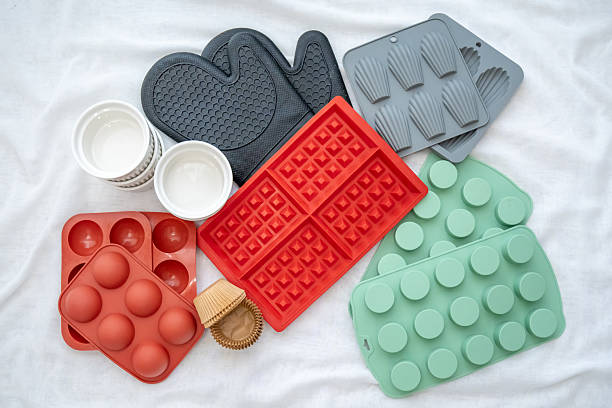
- Silicone baking molds and cake pans
- Silicone ice cube trays
- Silicone spatulas and cooking utensils
- Silicone food storage bags and containers
- Silicone suction plates and baby tableware
- Silicone pastry mats and baking accessories
These products may experience different conditions, including direct food contact, repeated washing, heating, freezing, and prolonged storage.
Therefore, material selection should consider the actual conditions of use rather than relying on a general material label.
Key Characteristics Buyers Should Evaluate
When evaluating food grade silicone kitchenware, buyers should consider:
- Temperature suitability: Whether the material is appropriate for the product’s intended heating, cooling, and storage conditions.
- Chemical stability: Whether the material maintains its intended properties under normal use.
- Odor and volatile substances: Whether the material has been properly processed and tested for relevant concerns.
- Mechanical performance: Whether the product has sufficient flexibility, tear resistance, and durability.
- Food contact compliance: Whether the material and finished product meet applicable requirements in the destination market.
These characteristics should be supported by appropriate technical information and test evidence.
2. What Is Ordinary Silicone?
Ordinary silicone is a broad term for silicone materials developed for general industrial, household, construction, electrical, or other non-food applications.
It may include different silicone rubber formulations, curing systems, additives, fillers, and performance characteristics. Some ordinary silicone products are designed for flexibility, sealing, insulation, weather resistance, or industrial durability rather than food contact.
Examples include:
- Industrial silicone seals and gaskets
- Silicone insulation components
- Construction and weatherproofing materials
- General-purpose silicone rubber parts
- Silicone components used in machinery and equipment
These products can perform well in their intended applications. However, their suitability for food contact cannot be assumed.
Why Ordinary Silicone Is Not Automatically Suitable for Kitchenware
A silicone product may look smooth, flexível, and durable without being appropriate for food contact.
The material formulation may contain ingredients or processing residues that have not been evaluated for food contact applications. Its manufacturing process may also lack the controls and documentation required for food-contact products.
For this reason, buyers should not use appearance, color, softness, or a supplier’s general statement as proof of food safety.
A product intended for kitchen use requires evidence that the relevant material and finished article are suitable for the expected conditions of food contact.
3. Food Grade Silicone vs. Ordinary Silicone: Key Differences
The main difference between food grade silicone and ordinary silicone is their intended application and the evidence supporting their suitability.
| Comparison Factor | Silicone de qualidade alimentar | Ordinary Silicone |
|---|---|---|
| Intended use | Designed for food contact applications | Designed for general-purpose applications |
| Material formulation | Selected for relevant food contact requirements | Depends on industrial or household requirements |
| Additives and pigments | Must be evaluated for intended food contact use | May not be assessed for food contact |
| Manufacturing controls | Should include suitable process controls | Varies by application and manufacturer |
| Testing requirements | Relevant food contact testing may be required | Food contact testing may not be available |
| Documentation | Should have applicable compliance and test records | Usually focuses on general material specifications |
| Typical applications | Baking molds, utensils, food containers | Seals, insulation, industrial components |
It is important to understand that food grade silicone is not necessarily a completely different base polymer. Both products may use silicone rubber as their primary material.
The difference lies in the formulation, production controls, intended application, and demonstrated compliance with relevant requirements.
4. Food Contact Compliance: What Buyers Need to Know
Food contact compliance is one of the most important considerations when purchasing silicone kitchenware for international markets.
Different countries and regions have different regulatory frameworks. Buyers should identify the destination market before requesting compliance documents from a supplier.
United States: FDA Food Contact Requirements
In the United States, the FDA regulates substances used in food contact applications under applicable provisions of the Federal Food, Drug, and Cosmetic Act and related regulations.
For silicone materials, buyers should verify the applicable regulatory basis for the specific formulation and intended conditions of use.
A supplier’s statement that a product is “FDA approved” should not replace a review of the relevant regulatory references and supporting evidence.
Buyers should clarify:
- Which material formulation is used?
- What regulatory provision or authorization supports the intended use?
- Does the supporting evidence cover the relevant food types and conditions of use?
- Does the documentation apply to the finished article or only to a raw material?
Not every silicone kitchenware product automatically qualifies for every food contact application.
European Union: Food Contact Material Requirements
For products sold in the European Union, food contact materials are subject to the general requirements of Regulation (EC) No 1935/2004.
Good manufacturing practice is addressed by Regulation (EC) No 2023/2006.
Depending on the material and application, additional national requirements and technical assessments may also be relevant. Silicone does not have one fully harmonized, EU-wide specific measure equivalent to the plastics regulation covering all silicone products.
Buyers should therefore check the requirements applicable to the product, destination country, and intended conditions of use.
Why Intended Conditions of Use Matter
Food contact suitability depends on more than the material name.
Important factors include:
- Food type: aqueous, acidic, alcoholic, fatty, or dry foods.
- Contact temperature: room temperature, refrigeration, cozimento, or cooking.
- Contact duration: brief contact or long-term storage.
- Repeated use: washing, heating, and reuse cycles.
- Product structure: thickness, surface area, and contact design.
A silicone baking mold, for example, may require different evaluation conditions from a silicone food storage container.
5. What Documents Should a Food Grade Silicone Kitchenware Manufacturer Provide?
For B2B buyers, supplier documentation is an important part of material verification. A reliable food-grade silicone kitchenware manufacturer should be able to explain the material used and provide relevant supporting records.
However, no single certificate proves that every silicone product is suitable for every food contact application.
1. Material Specification or Technical Data Sheet
A material specification or technical data sheet should identify relevant material information, such as:
- Silicone rubber type or grade
- Hardness range, commonly expressed in Shore A
- Color and pigmentation information
- Applicable temperature range
- Mechanical properties, where available
- Curing or processing information, where relevant
These details help buyers compare material options and confirm whether a proposed formulation meets product design requirements.
2. Food Contact Test Reports
Testing should be relevant to the applicable market, material, and intended conditions of use.
Depending on the regulatory framework, the test program may include:
- Overall migration testing
- Specific migration testing, where applicable
- Extractable or leachable substance assessment
- Sensory or odor evaluation
- Other chemical safety assessments required by the target market
For silicone products, the testing approach should be selected according to the applicable requirements and risk assessment.
Buyers should check the report’s sample description, test methods, conditions, resultados, laboratory details, and issue date.
A test report for one silicone formulation or product should not automatically be treated as evidence for every product from the same supplier.
3. Declaration of Compliance or Supplier Declaration
A declaration of compliance or supplier declaration may identify the applicable regulatory framework and the conditions under which the product is intended to be used.
Buyers should verify:
- The name and identity of the product or material
- The applicable regulation or standard
- The intended food types and conditions of use
- The issuing company
- The supporting technical documents
The required format and legal status of such declarations vary by market and product category.
4. Manufacturing and Quality Control Records
Food contact suitability also depends on production consistency.
Relevant supplier records may include:
- Incoming raw material inspection
- Batch and lot traceability
- Mixing and curing process controls
- Pigment and additive management
- Finished product inspection
- Nonconforming product handling
These records help buyers understand whether the supplier can maintain consistent production across repeat orders.
6. How to Evaluate Silicone Kitchenware Quality Beyond Material Grade
Even when a supplier uses an appropriate food contact silicone formulation, buyers still need to evaluate the finished product.
Material compliance and product performance are related but separate purchasing considerations.
Odor and Surface Condition
Strong or persistent odors may indicate processing, formulation, or storage issues that require further investigation.
Buyers should request a defined odor evaluation method rather than relying only on subjective descriptions such as “odorless.”
The product surface should also be checked for visible defects, incluindo:
- Bubbles or voids
- Uneven surfaces
- Flash or excess material
- Contamination
- Color inconsistency
- Deformation
Flexibility and Tear Resistance
Silicone kitchenware often needs to withstand repeated bending, demolding, and cleaning.
For baking molds, insufficient tear resistance may cause damage during product removal. For spatulas and utensils, excessive softness or poor structural design may affect handling.
Buyers should evaluate hardness, tensile strength, elongation, and tear resistance according to the product’s intended function.
Heat Resistance and Repeated Use
Not all silicone products have the same temperature performance.
A material’s stated temperature range should be supported by technical information and appropriate testing. Buyers should also consider whether repeated heating, cooling, and washing affect the product’s shape, surface, or mechanical properties.
For products used in ovens, dishwashers, freezers, or microwaves, the finished product should be evaluated under the conditions specified by the manufacturer.
7. How to Choose the Right Food Grade Silicone for Custom Kitchenware
Different kitchenware products have different material and structural requirements. Buyers should select silicone based on the product’s function, not simply request the softest or highest-priced material.
| Product Type | Key Material Considerations | Important Evaluation Points |
|---|---|---|
| Silicone baking molds | Heat suitability, flexibility, dimensional stability | Demolding, espessura da parede, shape retention |
| Silicone spatulas | Flexibility, tear resistance, structural strength | Edge performance, handle connection, repeated use |
| Silicone ice cube trays | Low-temperature flexibility, durabilidade | Ice release, deformation, limpeza |
| Silicone food containers | Food contact suitability, sealing design | Lid fit, leakage resistance, repeated washing |
| Silicone baby tableware | Food contact suitability, mechanical durability | Suction performance, edge finish, limpeza |
Match Material Hardness to Product Function
Silicone hardness affects flexibility and handling.
Softer silicone may be useful for flexible baking molds and easy demolding. Firmer formulations may be more appropriate for products that need to maintain their shape.
However, hardness alone does not determine product quality or food contact safety.
The final choice should consider product geometry, espessura da parede, intended use, and mechanical performance.
Confirm Pigment and Additive Suitability
Color customization is common in private-label silicone kitchenware.
However, pigments, additives, and other formulation components should be evaluated for the intended food contact application.
Buyers should confirm that custom colors are produced using suitable materials and that any relevant testing or compliance documentation covers the final formulation.
Changing the pigment or formulation may affect the validity of previous test results.
8. Questions to Ask Before Choosing a Silicone Kitchenware Supplier
Before placing a bulk order, buyers should ask suppliers specific questions about materials, documentation, and manufacturing controls.
Material and formulation
- Is the silicone formulation intended for food contact?
- Can you provide the material specification or technical data sheet?
- Are pigments and additives covered by the relevant material assessment?
Compliance and testing
- Which food contact requirements are relevant to my target market?
- Can you provide test reports for the proposed material or finished product?
- Do the reports cover the intended food types, temperatures, and contact duration?
- Can you explain the scope and limitations of the available documentation?
Manufacturing and quality control
- How are incoming materials inspected?
- How are production batches identified and traced?
- What inspection criteria are used for finished products?
- How are formulation changes and repeat orders controlled?
Customization and bulk orders
- Can you customize product dimensions, colors, shapes, and logos?
- Will the final customized product require additional testing?
- Can you provide pre-production samples for approval?
- How do you maintain consistency between samples and mass production?
A supplier that answers these questions clearly can help reduce sourcing uncertainty and improve long-term purchasing consistency.
9. Common Mistakes Buyers Should Avoid
When sourcing silicone kitchenware, buyers should avoid several common assumptions.
Mistake 1: Assuming all silicone is food grade
Silicone is a broad material category. General-purpose silicone should not be used for food contact without appropriate evidence of suitability.
Mistake 2: Treating an FDA-related statement as universal approval
A supplier’s marketing statement is not a substitute for checking the applicable regulatory basis and supporting documents.
Mistake 3: Assuming a raw material report covers every finished product
Finished-product design, pigments, additives, processing, and intended use may affect the required assessment.
Mistake 4: Ignoring destination-market requirements
A document relevant to one market may not satisfy the requirements of another. Buyers should define the destination market before finalizing material specifications.
Mistake 5: Focusing only on material price
A lower material price may not reflect the total cost of ownership. Buyers should also consider documentation, consistency, production control, defect rates, and product durability.
10. Frequently Asked Questions
Is food grade silicone safer than ordinary silicone?
Food-grade silicone is formulated and evaluated for intended food contact applications. Ordinary silicone may be designed for industrial or general-purpose use and may not have the required food contact evidence. Buyers should verify the specific material and finished product rather than relying on the name alone.
Can ordinary silicone be used to make kitchenware?
Not automatically. Ordinary silicone should only be used in food contact applications if the specific formulation and finished product have been demonstrated to meet the relevant requirements for the intended conditions of use.
Does food grade silicone have no smell?
Not necessarily. Odor can be influenced by formulation, curing, processing, and storage. Buyers should request appropriate odor evaluation and investigate strong or persistent odors rather than treating the absence of smell as proof of compliance.
Is food grade silicone suitable for oven and microwave use?
Some food contact silicone products are designed for oven or microwave use, but suitability depends on the specific formulation, product construction, and manufacturer’s instructions. Buyers should confirm the stated temperature and usage limits for the finished product.
What documents should buyers request from a food grade silicone supplier?
Commonly requested documents include material specifications, relevant food contact test reports, supplier declarations, and manufacturing quality records. The exact documents depend on the destination market and intended product application.
Can customized silicone kitchenware still meet food contact requirements?
Yes, customization is possible, but changes to pigments, additives, material formulations, or manufacturing processes may affect compliance. Buyers should confirm that the final customized product is covered by the relevant assessment and supporting documentation.
Conclusion
The difference between food-grade silicone and ordinary silicone is not simply appearance, flexibility, or material cost. It comes down to intended application, formulation, manufacturing controls, and evidence of food contact suitability.
For buyers sourcing silicone kitchenware, the most effective approach is to define the product’s intended use, identify the destination-market requirements, review relevant material and finished-product documentation, and verify manufacturing consistency before bulk production.
Working with an experienced food-grade silicone kitchenware manufacturer can make material selection, product customization, and quality control more manageable. Yongcheng supports customized food-grade silicone kitchenware and mold sourcing requirements. Contact our team to discuss your product design, material specifications, and documentation needs.