

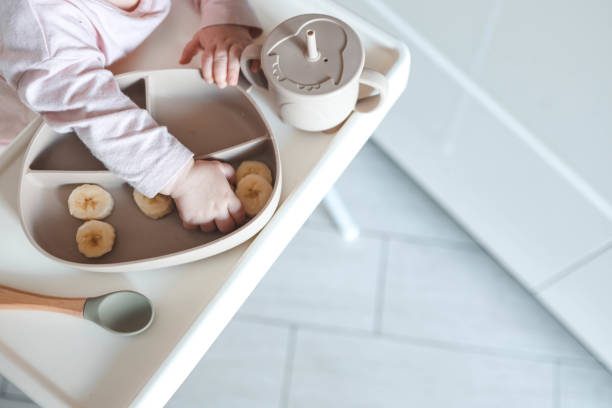
When sourcing soft silicone baby products, including suction plates, baby bowls, feeding bibs, training spoons, and complete feeding sets, procurement teams often face a difficult question: why do products with similar appearances have such different prices?
The answer goes beyond the label “100% food-grade silicone.” Silicone formulation, curing chemistry, post-curing conditions, and quality control can all affect the finished product’s odor, surface condition, durability, and food-contact compliance.
Two common curing systems are platinum curing (addition curing) and peroxide curing. Although both can produce cross-linked silicone elastomers, their reaction mechanisms and potential residual by-products differ. Post-curing may also help reduce residual volatile compounds when the formulation and manufacturing process require it.
For baby product brands targeting demanding retail markets, understanding these differences helps reduce sourcing risks and establish more reliable quality standards.
This guide compares platinum-cured silicone and peroxide-cured silicone, explains why post-curing matters, and outlines practical ways to evaluate a silicone baby product manufacturer.
1. Platinum Cured Silicone vs. Peroxide Cured Silicone: Key Differences
The curing system determines how silicone polymers form a cross-linked network. However, the catalyst alone does not determine the final product’s safety or quality. The complete formulation, processing conditions, finishing, and testing also matter.
Platinum-cured silicone: Addition curing
Platinum-cured silicone uses a platinum-based catalyst to promote an addition reaction between vinyl-functional silicone and a hydride-containing cross-linker.
This reaction does not generate the same decomposition by-products associated with organic peroxide curing. As a result, properly formulated and processed platinum-cured silicone can be a suitable option for applications that require low odor, good surface quality, and consistent material performance.
Key characteristics include:
- Low by-product formation: The addition-curing reaction does not produce stoichiometric volatile by-products, although residual ingredients and other volatile compounds may still be present.
- Low-odor potential: Appropriate formulation, curing, and post-curing can help achieve low-odor finished products.
- Consistent surface quality: Well-controlled processing supports a smooth, uniform finish for feeding accessories.
- Material flexibility: Suitable silicone grades can provide the softness, elasticity, and tear resistance required for different baby product designs.
For brands developing premium silicone feeding products, platinum curing can offer manufacturing advantages. However, buyers should still verify finished-product performance through appropriate testing.
Peroxide-cured silicone: Free-radical curing
Peroxide curing uses an organic peroxide that decomposes under heat to initiate cross-linking. Depending on the peroxide chemistry and formulation, the process may generate residual decomposition products that require appropriate control.
Post-curing can help remove residual volatile compounds and improve the finished material’s odor profile. The outcome depends on the peroxide system, processing conditions, product geometry, and post-curing protocol.
Potential considerations include:
- Residual decomposition products: The selected peroxide system determines which by-products may form.
- Odor control: Inadequate processing or insufficient post-curing may contribute to unwanted odor.
- Process sensitivity: Temperature, curing time, and formulation must be controlled to achieve consistent results.
- Verification requirements: Finished products should be evaluated against the applicable food-contact and sensory requirements.
Peroxide curing is not automatically unsafe or non-compliant. A properly formulated and processed product must be judged against its intended use and verified performance, rather than its curing method alone.
Platinum vs. peroxide silicone: Comparison table
| Evaluation factor | Platinum-cured silicone | Peroxide cured silicone |
|---|---|---|
| Curing mechanism | Platinum-catalyzed addition reaction | Organic peroxide-initiated cross-linking |
| Reaction by-products | Addition reaction does not generate stoichiometric volatile by-products | Peroxide decomposition may generate residual by-products |
| Odor management | Can support low-odor production with suitable processing | Depends on formulation, curing, and post-curing |
| Post-curing | May be required to reduce residual volatiles and meet specifications | May be important for removing residual decomposition products |
| Surface finish | Depends on formulation, tooling, and process control | Depends on formulation, tooling, and process control |
| Food-contact compliance | Requires verification for the intended application | Requires verification for the intended application |
| Procurement priority | Verify purity, finished-product performance, and test results | Verify residual control, finished-product performance, and test results |
2. Why Post-Curing Matters for Silicone Baby Products
Post-curing is a secondary thermal treatment applied to some silicone products after their primary molding and curing stages. Manufacturers use it to reduce residual volatile substances and help the material achieve its required performance.
For soft silicone baby products, post-curing may be particularly relevant when the finished items have thick sections, large contact surfaces, or demanding odor and migration specifications.
How the post-curing process works
A typical manufacturing workflow includes the following stages:
- Material preparation: The manufacturer selects a silicone compound suitable for the product’s intended application.
- Primary molding and curing: The compound is molded into the required shape and cured under controlled conditions.
- Post-curing, where required: The product undergoes a secondary heat treatment based on the material supplier’s recommendations and the product specification.
- Cooling and inspection: The manufacturer checks the product’s appearance, dimensions, surface condition, and other defined quality characteristics.
- Finished-product testing: Applicable food-contact, migration, or sensory testing verifies whether the product meets the specified requirements.
Post-curing parameters should be established through material guidance and process validation. Temperature and duration should not be treated as universal values for every silicone formulation.
Does silicone always need to be baked at 200°C for 4–6 hours?
No. A post-curing cycle of 200°C for 4–6 hours may be appropriate for certain materials and product designs, but it is not a universal requirement for all silicone baby products.
The appropriate conditions depend on several factors:
- Silicone formulation and curing system
- Product thickness and overall geometry
- Primary curing conditions
- Target residual volatile levels
- Oven airflow and temperature uniformity
- Product performance and regulatory requirements
A supplier should be able to explain its post-curing process and provide evidence that the selected parameters are suitable for the material and product.
What can happen when post-curing is insufficient?
If the material requires post-curing but receives inadequate treatment, residual volatile compounds may contribute to unwanted odor or changes in surface condition. Certain formulations may also develop deposits or other visible changes during storage or repeated use.
However, a sticky surface, white residue, or unpleasant odor does not identify a single cause. These symptoms may also relate to formulation, contamination, molding conditions, storage, or cleaning.
For this reason, buyers should investigate recurring defects through process records and laboratory analysis instead of assuming that every issue results from peroxide curing or insufficient baking.
3. How Material Choice Affects Baby Feeding Product Quality
The difference between silicone formulations becomes commercially important when a brand needs consistent performance across an entire product range.
A suction plate, a soft bib, a bowl, and a training spoon may have different thicknesses, shapes, and functional requirements. A single material specification may not be appropriate for every component.
Odor and taste transfer
Silicone feeding products may contact warm food, liquids, and cleaning agents. Unwanted odor or flavor transfer can therefore become a product-quality concern.
Platinum-cured silicone can help manufacturers develop low-odor products, but the final result also depends on raw materials, processing, cleaning, packaging, and storage.
For food-contact applications, buyers should specify the required sensory performance and request appropriate test reports rather than relying on the phrase “odorless silicone.”
Surface feel and appearance
A smooth, non-sticky surface supports the perceived quality of premium feeding accessories. Surface characteristics depend on the silicone compound, mold finish, curing conditions, and post-processing.
A velvet-like or dry-touch finish may be desirable for some products, but it is not exclusive proof of platinum curing or material purity.
Likewise, stress whitening during stretching can have multiple causes, including material formulation, fillers, geometry, and mechanical deformation. It should not be used as a standalone test for catalyst type.
Durability and cleaning resistance
Baby feeding products may undergo repeated washing, hot-water exposure, or sterilization according to their care instructions.
Manufacturers should evaluate the selected silicone grade under the intended conditions. Relevant checks may include dimensional stability, surface changes, tearing, deformation, and odor after repeated cleaning cycles.
Avoid assuming that every platinum-cured product is automatically dishwasher-safe or suitable for every sterilization method. Confirm the manufacturer’s validated care instructions for the finished product.
4. Food-Grade, Platinum Cured, and Medical Grade Silicone: What Buyers Should Verify
These terms describe different aspects of a material and should not be treated as interchangeable certifications.
Food-grade silicone generally refers to silicone intended to meet applicable food-contact requirements. The exact requirements depend on the destination market, the intended use, and the materials involved.
Platinum-cured silicone identifies a curing chemistry. It does not automatically establish compliance with every food-contact regulation.
Medical grade silicone is a material or marketing description that needs context. Buyers should confirm the applicable specification and evidence for the intended medical or consumer application rather than treating the term as a universal certification.
What about EU LFGB and FDA requirements?
For silicone baby feeding products, buyers should identify the regulations and test methods applicable to the destination market and product category.
Depending on the product and intended use, an evaluation may include:
- Relevant food-contact migration or extraction testing
- Sensory evaluation of odor and taste transfer
- Assessment of applicable restricted substances
- Material declarations and traceability records
- Finished-product testing under the specified conditions of use
In Europe, LFGB-related requirements and relevant test methods should be selected according to the product and its intended use. DIN 10955 may be relevant to sensory evaluation in applicable contexts, but the precise test scope should be confirmed with the testing laboratory.
In the United States, 21 CFR 177.2600 covers certain rubber articles intended for repeated use in contact with food. Buyers should verify whether the provision applies to their specific silicone article and confirm the relevant compositional and extraction requirements.
Neither platinum curing nor a supplier’s general “food-grade” declaration proves that a finished product passes every applicable test. Request current documentation that matches the product, material, manufacturing site, and intended market.
5. How to Inspect Silicone Baby Products Before Bulk Ordering
A reliable supplier qualification process combines sample inspection, documentation review, and appropriate laboratory testing.
Step 1: Review the material documentation
Ask the manufacturer to identify the silicone grade, curing system where relevant, material supplier, and intended food-contact application.
Request supporting declarations and test reports. Check whether the documentation covers the exact product or material being purchased and whether the tested formulation matches the production specification.
Step 2: Conduct a visual and tactile inspection
Inspect samples for visible contamination, uneven coloration, molding defects, flash, rough edges, and unexpected surface tackiness.
These checks are useful for identifying obvious quality problems, but they cannot independently verify the curing chemistry, chemical composition, or regulatory compliance.
Step 3: Check odor without tasting the product or test water
Open the packaging in a clean environment and assess whether the sample has an unexpected or strong odor. If necessary, follow a controlled evaluation protocol agreed with the supplier or laboratory.
Do not taste the product or water used in an informal boiling test. Sensory observations can identify a reason for further investigation, but they do not replace validated food-contact testing.
Step 4: Test the finished product against its intended use
For products designed for repeated washing or hot-food contact, establish relevant test conditions before approving production.
Depending on the risk assessment, verification may include migration or extraction testing, sensory evaluation, cleaning-cycle testing, and dimensional or mechanical checks.
Step 5: Approve a production specification
Before bulk manufacturing, document the approved material, color, dimensions, surface finish, applicable compliance requirements, inspection criteria, and change-control procedure.
If a supplier changes the formulation, curing system, or processing conditions, determine whether additional validation is required.
Frequently Asked Questions
Is platinum cured silicone safer than peroxide cured silicone for baby products?
Platinum curing can offer advantages for applications that require low odor and controlled residual by-products. However, safety depends on the full formulation, manufacturing process, intended use, and verified compliance of the finished product. The curing method alone does not prove that a product is safe.
Does platinum cured silicone always have no odor?
No. Properly formulated and processed platinum cured silicone can achieve low-odor performance, but residual ingredients, contamination, packaging, and storage may still affect the finished product. Buyers should define sensory requirements and verify them through suitable testing.
Does every silicone baby product require post-curing at 200°C for 4–6 hours?
No. Post-curing requirements vary by formulation, product design, and performance target. Manufacturers should establish and validate suitable conditions for the specific material and product rather than applying one cycle universally.
Can I identify platinum cured silicone using a smell or stretch test?
No. Smell, surface feel, and stress whitening can reveal potential quality concerns, but none reliably identifies the curing system. Request material documentation and use appropriate laboratory analysis when independent verification is necessary.
What documents should I request when sourcing LFGB-compliant silicone baby products?
Request applicable declarations, current laboratory reports, material identification, traceability information, and test results covering the relevant product and intended use. Confirm the scope of each report and whether it addresses the applicable sensory and migration requirements.
What should I compare when choosing a custom silicone baby feeding set supplier?
Compare material suitability, product design, molding quality, curing and post-curing controls, testing capability, customization options, production consistency, and change management. Evaluate the total compliance and quality package instead of selecting a supplier based on price alone.
Partner with Yongcheng for Custom Silicone Baby Products
Developing a reliable silicone baby feeding product line requires coordinated control of material selection, product design, molding, finishing, and quality verification.
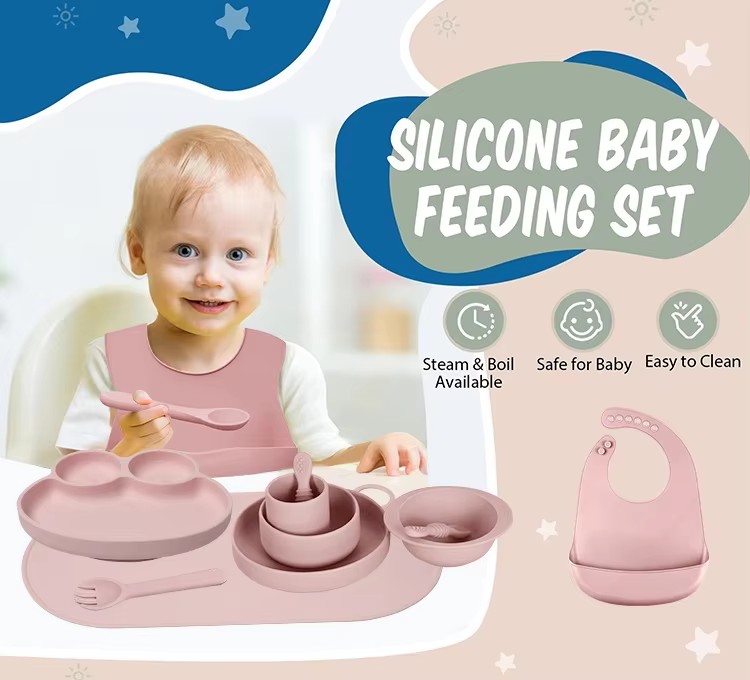
Yongcheng supports custom silicone baby feeding products, including suction plates, bibs, bowls, cups, spoons, forks, and placemats. Brands can discuss product configurations, colors, design requirements, and OEM customization with the manufacturing team.
If you are sourcing soft silicone baby products for your own brand, request the relevant material documentation, food-contact test reports, and manufacturing specifications before placing a bulk order.
Explore the Yongcheng Custom Silicone Baby Feeding Set to discuss your product requirements and request a customized quotation.