

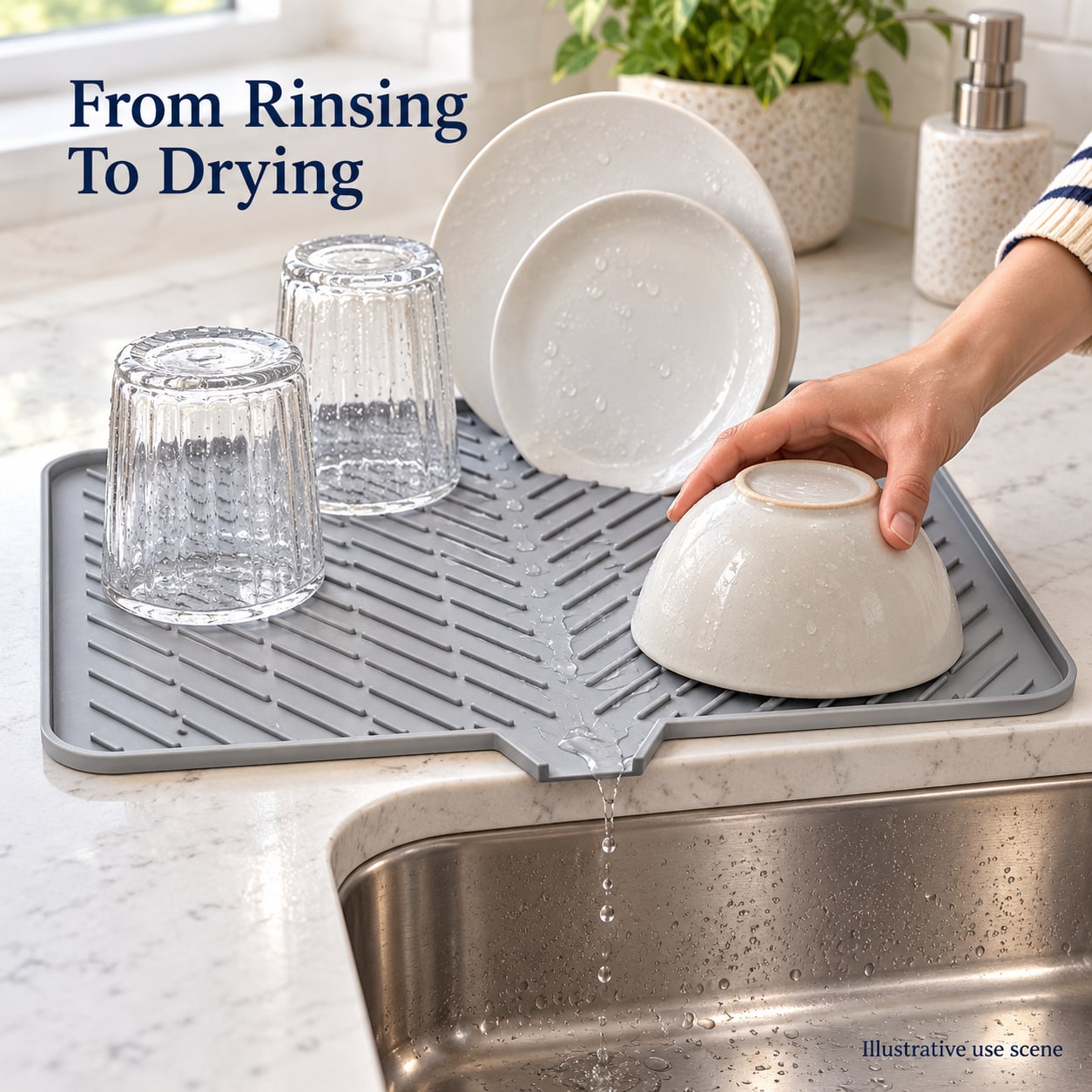
A good kitchen accessory earns its place through everyday use. Silicone dish drying mats give kitchenware retailers a product story that is easy to demonstrate: place freshly washed dishes on the raised ribs, position the drainage outlet over the sink, then rinse and reuse the mat.
For private-label brands and wholesale buyers, the opportunity is not simply to add another product carrying a green label. It is to offer a useful, repeat-use design with clear dimensions, convincing application images and a material story customers can trust.
Consumer Data Supports a More Considered Kitchen Range
Recent research provides encouraging context for brands building reusable homeware collections:
25.4%
2025 US branded CPG market share for products marketed as sustainable in NYU Stern and Circana’s analysis.[1]
10.9%
Five-year compound annual growth for sustainability-marketed products, versus 2.2% for conventional counterparts in the same research.[1]
36.8% / 42%
2024 UK / Germany shares of branded products marketed as sustainable across the 34 CPG categories analyzed.[1]
NYU Stern’s US analysis covers 36 consumer packaged goods categories, representing approximately 40% of US CPG sales and excluding alcohol and tobacco. It tracks products marketed with sustainability attributes, not an environmental certification. The European figures use a separate 34-category analysis. These are broader shopping signals, not silicone kitchenware market shares or forecasts for drying-mat sales.
Online retail also offers a substantial route to customers. Eurostat reports that 78% of EU internet users aged 16 to 74 bought goods or services online in 2025, compared with 62% in 2015. For homeware sellers, that makes clear product photography, accurate measurements and useful care information worth prioritizing.[2]
Sell the Everyday Use, Not Just the Material
A sloped silicone drying mat has a visual advantage for a product listing: buyers can see how the raised ribs, drainage channels and outlet work together. Show washed bowls, glasses and plates on the mat beside a sink, rather than relying on an empty-product photograph alone.
- Show the water path. Position the outlet above the sink edge and demonstrate where water is intended to go. Check drainage on the customer’s actual counter and sink arrangement.
- Show usable space. Include familiar dishes and a dimension image so customers can judge the footprint before ordering.
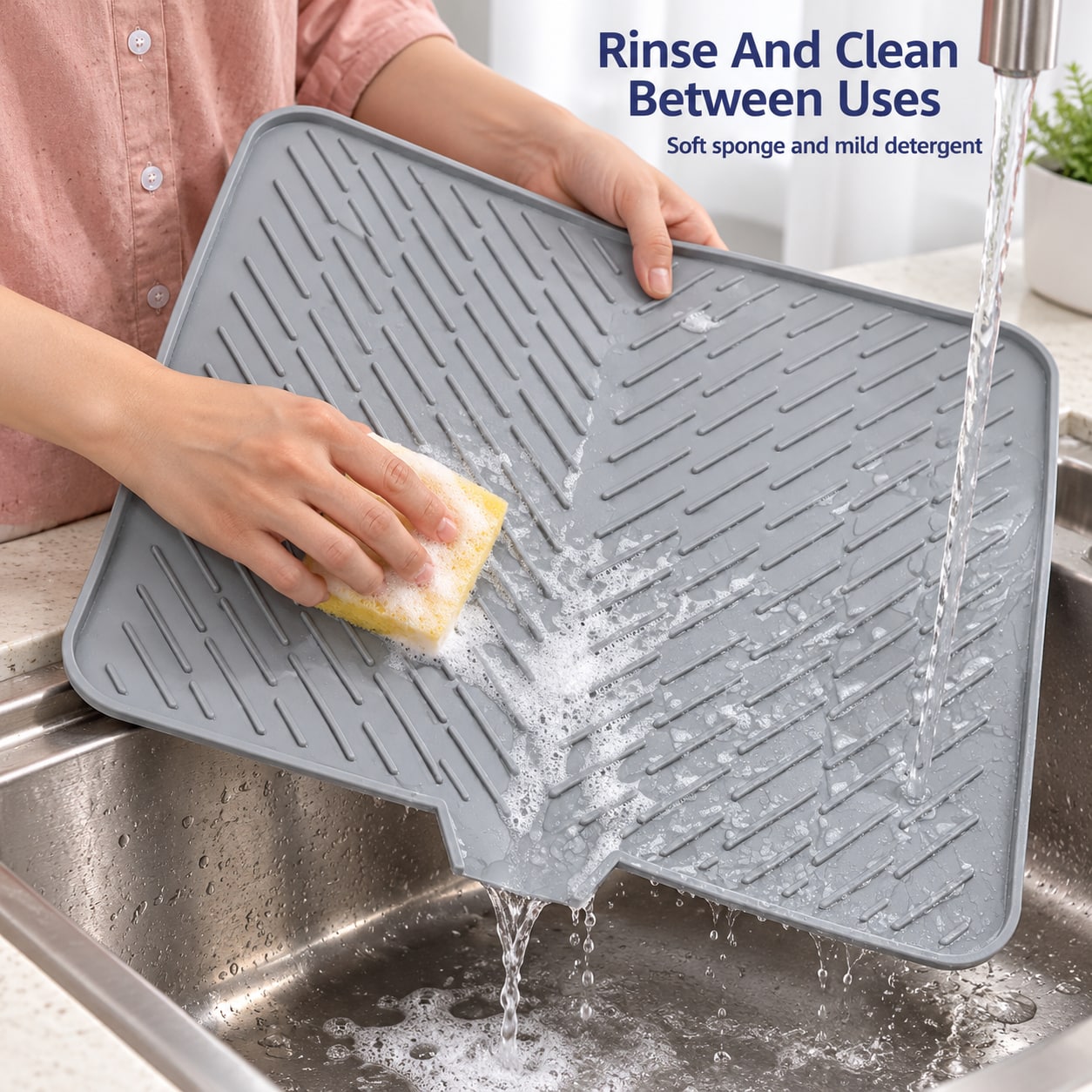
- Show cleaning access. Demonstrate washing between the ribs with a soft sponge, followed by rinsing and drying before storage.
This is a practical household product, not a substitute for washing dishes or cleaning the sink area. Performance depends on placement, loading and the approved design.
Two Sizes and Three Colors Create a Clear Starting Assortment
Yongcheng’s silicone sloped dish drying mat is presented in a large 58 x 43 x 1 cm format and a small 30 x 40 x 1 cm format. Both sizes are shown in Gray, Black and Ivory, giving buyers six size-and-color combinations to consider for their range.
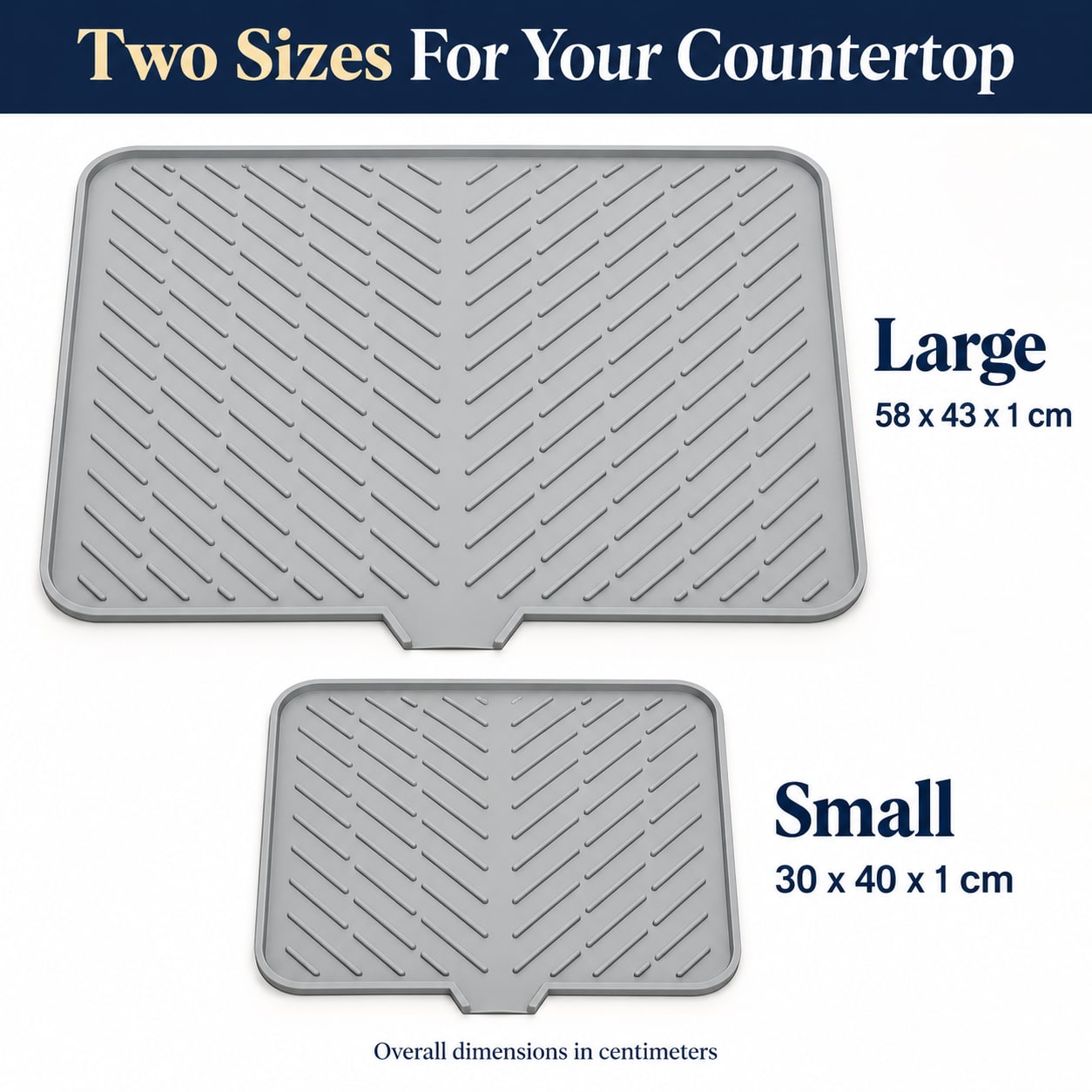
A compact option and a larger option let retailers address different counter layouts without presenting customers with an overwhelming assortment. Use the actual dimensions in the title, specification table and packaging; avoid promising compatibility with every sink.
Where the Reusable Design Can Add Value
The strongest environmental story starts with continued use. A washable mat that remains useful in the kitchen can support a repeat-use routine. That is a more specific message than describing every silicone product as automatically better for the environment.
When comparing a silicone mat with a fabric drying mat or a rigid tray, evaluate the same job: managing washed dishes in a defined space over a realistic service life. Include manufacturing, delivery, washing, replacement frequency and disposal in the assessment. A lower-impact claim needs evidence for the particular products and use conditions being compared; there is no single percentage reduction that applies to every silicone mat.
For buyers, the practical specification priorities are straightforward: a body that withstands the intended cleaning routine, ribs that are accessible for washing, a drainage outlet that suits the placement, and packaging that protects the product without unnecessary layers.
Recycling is another area where precision matters. Silicone recycling technologies are developing, including specialist mechanical and chemical routes described by silicone producer Elkem.[3] Their existence does not establish a local collection route for a finished household mat. Confirm the destination market’s collection options before making a recyclability promise. Do not use biodegradable, compostable or recycled-content labels without evidence for the supplied product.
What to Confirm Before a Wholesale or OEM Order
- Approve the geometry. Check dimensions, edge shape, channel direction, outlet reach and how the loaded mat sits beside the sink.
- Evaluate the sample in use. Test the proposed dish load, drainage and repeated cleaning. Agree on acceptance criteria rather than claiming an untested service life.
- Define the material requirements. Confirm formulation, intended use and the documentation needed for your destination market. Do not assume a drying mat has the same heat or food-contact specification as a baking mold.
- Plan the private-label details. Discuss color references, logo placement, packaging format, language and care instructions before bulk production.
- Build a useful product page. Lead with the product, follow with dimensions, then show use and cleaning. Keep the description consistent with the approved sample.
Yongcheng supports wholesale and OEM ODM silicone-product projects from Dongguan, China. Buyers can begin with an existing mat format and discuss color, branding and packaging requirements, or send a drawing and target application for a custom project review.
Explore the Silicone Drying Mat Discuss Your OEM Project
Sources and Data Scope
- NYU Stern Center for Sustainable Business and Circana, Sustainable Market Share Index. US figures: 2025 findings; UK and Germany: 2024 data. Broad CPG research, not a silicone-mat sales study.
- Eurostat, E-commerce statistics for individuals. 2025 survey results; data extracted February 2026. Online-purchase figures refer to EU internet users aged 16 to 74 and the preceding 12 months.
- Elkem, Lower Carbon and Circular Silicones. Industry context for recycling technologies; no claim that this mat uses Elkem material or contains recycled silicone.
Research checked 28 October 2026. Market statistics describe their stated datasets and are not a sales guarantee or a product-specific environmental assessment.